Algorithmic Cartels and Antitrust Law: How Pricing Algorithms are redefining Market Collusion

– Naman Aggarwal
Introduction
On 7th January 2025, United States Department of Justice sued six landlords for participating in algorithmic pricing that harmed renters. It harmed more than 1.3 million renters across the 43 US states. They shared sensitive information about rental prices and used algorithms to coordinate to keep the price of rent high. This is one such instance where market players engaged in anti-market behaviour using the pricing algorithms and today, in the age of digitalisation and high network effects, it has become a common mode to carry out the anti-competitive practices.
Algorithm refers to a set of automatised computational sequences which processes the input into output on the basis of certain formulas and those algorithms which provides the determination of the price of a product as the output are known as pricing algorithms.
This post discusses the types of pricing algorithms which are employed by the market players and the ways in which these algorithms are employed to exploit behavioural biases of the consumers. It further discusses the need for regulation of pricing algorithms and the measures through which these anti-competitive practices can be checked.
Types of Pricing Algorithms
The use of pricing algorithms is not per se anti-competitive but if algorithms are designed in a particular manner to harm the market, then it can be investigated under the antitrust regime. There are generally four types of basic pricing algorithms, the combination of which is employed by the market players to collude and carry out anti-competitive practices. These are monitoring algorithms, parallel algorithms, signalling algorithms and self-learning algorithms.
Monitoring Algorithms:
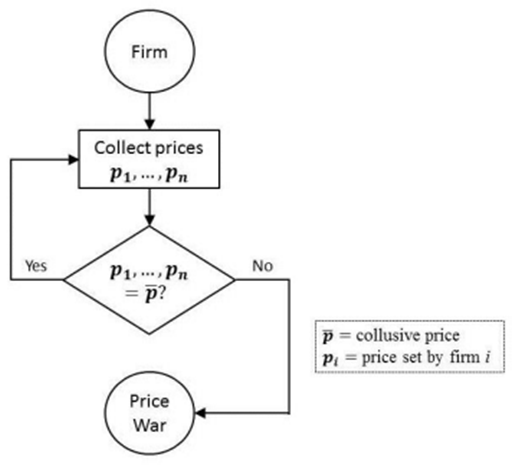
These are the type of algorithms which monitor the price of other market players and use that data as it input. These algorithms, however, do not eliminate the need for the explicit communication between market players to establish and implement cartel but helps them in enduring collusion by continuously monitoring if the collusive price is being followed or not. It can better be understood with the help of the enclosed figure. The firm’s algorithm collects price data from all market players and whether the prices of all the other market players are equal to the collusive price or not. If the prices are equal then it keeps continue the monitoring, otherwise price war happens. Since the algorithms are very fast at detecting any kind of deviation, no market player has any incentive to deviate from the decided collusive price.
Spain’s antitrust regulator CNMC, in 2019, fined several companies of EUR 1.25 million for engaging in anti-competitive concerted practices through monitoring algorithms. These real estate companies imposed minimum brokerage commissions and used an algorithm named as Multiple Listing System (MLS) for its facilitation. CCI, on the other hand, hasn’t dealt with any such cases till now.
Parallel Algorithms:
It is very difficult for the market players to tacitly collude in a highly dynamic market due to continuous changes in market conditions such as supply prices, consumer demand, other trading conditions etc. This requires frequent communications through telephone, e-mails, fax etc. which increase the risk of the detection of cartel. To overcome this issue, one solution is to automatise the decision making process of all the colluding players so that prices react simultaneously to any changes in market conditions and here comes the parallel algorithms to their assistance.
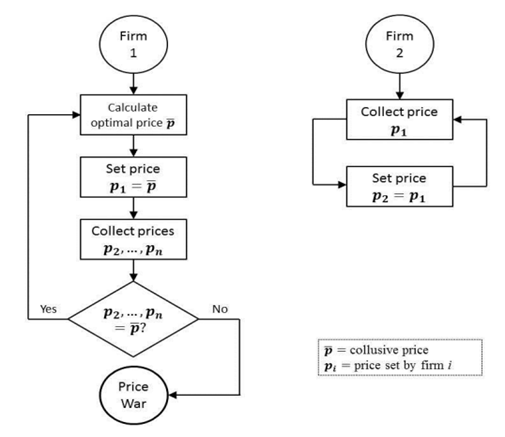
As the name suggests, when the firms use same algorithms each of which processes the input in the same way to give the same output, then it is known as parallel algorithms. As can be understood with the help of figure, the Firm 1, which is the leader firm, sets the price and the Firm 2, which is the follower firm, simply follows the price set by the leader firm. As discussed earlier that since no firm has the incentive to deviate from the collusive price, the collusion continues until noted by the regulators.
These kinds of algorithms can be used as catalysts to hub and spoke settings. If two or more companies employs the same third-party software, then it can used for facilitating information exchange. For example, the travel agencies which uses the same online booking system such as Oyo, MakeMyTrip etc. can enter into a tacit collusion and conduct concerted anti-competitive practices like limited discounts, higher prices etc. A case on similar lines was filed against the Ola/Uber before the CCI back in 2018, however, CCI didn’t find any prima facie case of contravention by adopting a ‘forms based analysis’.
Signalling Algorithms:
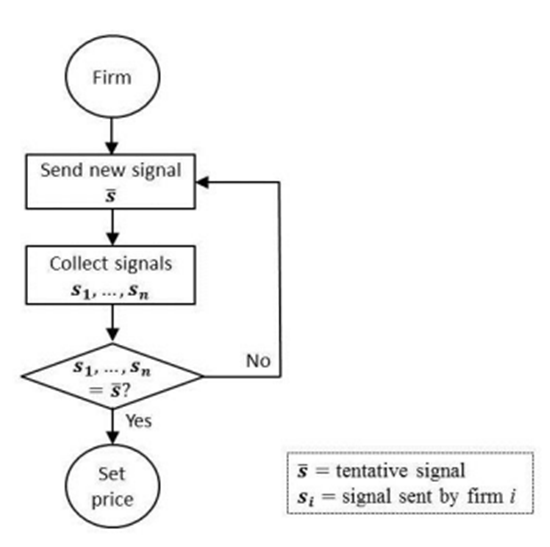
Another kind of algorithms which assists collusion in a highly dynamic market are signalling algorithms. These are the algorithms used to send the signal in the market and reveal the intention to collude without any need of explicit communication. It can be more effectively understood with the help of accompanying figure. In the figure, a firm sends a signal in the market by increasing its price to s̅. It then collects the prices of other competitors and check if anyone has reacted to the signal by increasing their prices. If the competitors have reacted by increasing their prices, then the new collusive price is set otherwise the firm keeps sending signals.
Self-Learning Algorithms:
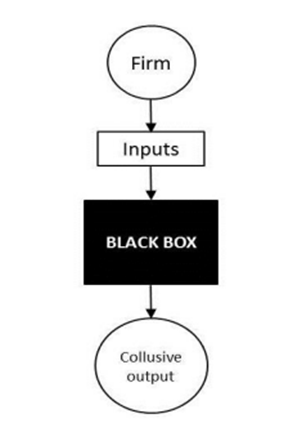
These are the kind of algorithms which use complex machine learning and deep learning technologies to reach to a collusive output even without explicitly programmed by the competitor to do so. In other words, these algorithms with powerful predictive capacity, by constantly learning and readapting to the actions of other market players will be able to collude without the need for any human intervention. As can be understood from the figure, the algorithm takes the information about market conditions, demand, supply etc. as its input and processes it using complex machine learning and deep learning technologies referred as black box to produce a collusive price as output.
Till now, there is no regulatory authority which has dealt with such kind of algorithms. However, various economists called for the regulators and the academicians to look for and research upon the possible consequences which these algorithms can pose upon the market.
Need for Regulation
Almost all the competition authorities today agree on the fact that the current antitrust tools are not the most appropriate to face the reality of the risks imposed by pricing algorithms. One main reason cited for the regulation of pricing algorithms is the lack of transparency in which they are programmed. Currently, there exists no law/obligation on the market players to disclose the program codes which they use to process the data and arrive at the output. The lack of transparency in the way algorithms are programmed and operate may limit consumers’ ability to make valid and conscious choices among competing products. Likewise, law enforcers may lack the necessary information or even expertise to make sure that automated systems comply with existing regulations.
Additionally, the development of good predictive algorithms requires expensive complementary assets such as advanced data mining and machine learning software, as well as physical infrastructures such as data centres, whose investment is subject to economies of scale. The ability of algorithms to find new relations and patterns of behaviour also requires access to a variety of data collected from multiple sources, resulting in economies of scope. Thereby, small firms that do not have the necessary complementary assets or that are not simultaneously present in multiple markets might face barriers to entry, preventing them from developing algorithms that can effectively exert competitive pressure. Thus, it becomes imperative that the pricing algorithms are being regulated in some sense because of the problems they pose and negative effect they cast on the market.
Way Forward
As discussed in the previous section, it is now clear that the pricing algorithms must be kept in check in some manner, but it also must be ensured that they are not overregulated. One thing which the regulatory authorities can focus on is algorithm auditing. Ezrachi and Stucke (2017) suggest that detection could be enhanced through auditing of algorithms by agencies or regulators to ‘assess whether an algorithm was designed to foster a change in the market dynamics. In essence, such approach resembles ex-ante merger appraisal – focusing on whether a proposed action would lead to a harmful change in market structure. Accordingly, algorithms could be activated in a ‘sand box’ where their effects will be observed and assessed.’
Another thing which can be done to promote the transparency of the pricing algorithms is the use of blockchain technology. Blockchain technology is a decentralised, distributed, and immutable ledger that records transactions across a network of computers, ensuring transparency and security. Firms can use this technology in operating pricing algorithms and regulators, subject to certain rules and conditions, can directly investigate if it observes any anti-competitive practices.
Additionally, one of the most important factors is to improve the specialist skills of the regulatory authorities’ staffs. As per the GCR Rating Enforcement 2022, no competition authority has more than 6% of the staff who specialises in data analysis. The role of data analysts is necessary for analysing the algorithms and ensure that the algorithms are programmed properly to follow the rules and regulations set.
Conclusion
The increased prevalence of pricing algorithms in digital markets creates serious challenges for the enforcement of competition law. Pricing algorithms are capable of enhancing efficiency and automating pricing practices, but they also carry the risk of anti-competitive conduct, such as collusion and the abuse of a position of strength, completely independent of any explicit human actors engaging in an arrangement. In the absence of transparency or the normal checking mechanism of regulation, firms could use their algorithms as a covert means of price manipulation, taking advantage of consumer biases, and creating barriers to entry for smaller firms.
Ultimately, competition authorities will have to find the right balance in how they regulate them. Some regulatory measures could include some version of algorithm auditing, imposing a transparency obligation through some other form of technology, such as blockchain, or the regulatory authority enhancing its own sophistication with data analytics within the authority itself. Naturally it is essential to avoid overly regulatory measures that would inhibit innovation and therefore price competition or other efficiencies in the market. This means a proactive, but flexible regulatory approach is needed to reconcile the anti-competitive risks of algorithm price price-setting with the benefits of algorithmic drivers of pricing as the digital economy continues to evolve.
The author is a student of Dr. Ram Manohar Lohiya National Law University.