When Policy Blurs the Lines, the Markets Pay the Price: A Commentary on the Competition Commission of India (Determination of Cost Production) Draft Regulations, 2025.

– Sara Dharwadkar
Introduction
At the core of every predatory pricing investigation lies one deceptively simple question: what does it really cost to make something? The process of calculating this cost is known as ‘cost determination.’ It serves as a pivotal value especially in cases of predatory pricing by essentially acting as a fulcrum on which billion-rupee competition battles can turn. If a company is accused of selling products ‘below cost’ to drive out competitors, it presents to be undeniable evidence of predatory pricing. Therefore, this makes it crucial for the Competition Commission of India (CCI) to determine this ‘cost’ via a method that is not only clear and reliable but also in tandem with the market realities of the economy.
The Competition Commission of India (Determination of Cost Production) Regulations, 2025 (Draft) seeks to modernize this very cost assessment framework under the Competition Act, 2002 while updating the pre-existing 2009 Regulations to introduce greater flexibility in cost determination for cases of predatory pricing.
This article aims to critically evaluate the economic feasibility of such proposed regulations by analyzing its impact on businesses, compliance costs, and market efficiencies. It further contrasts India’s approach with global competition law frameworks and provides policy suggestions to strike a balance between the market competition and regulatory efficiency.
Predatory Pricing
Predatory pricing is prohibited under Section 4 (2) (a) (ii) of the Competition Act. The CCI assesses predatory pricing based on the following parameters:
- The firm must have substantial market control.
- The price must be lower than the cost of production.
- The practice must be intended to eliminate competition, not just being competitive.
Theoretically, while predatory pricing benefits consumers in the short term, the long-term burden is borne not only by the consumers, but also the market in the form of reduced competition, monopolistic pricing and potential deadweight loss.
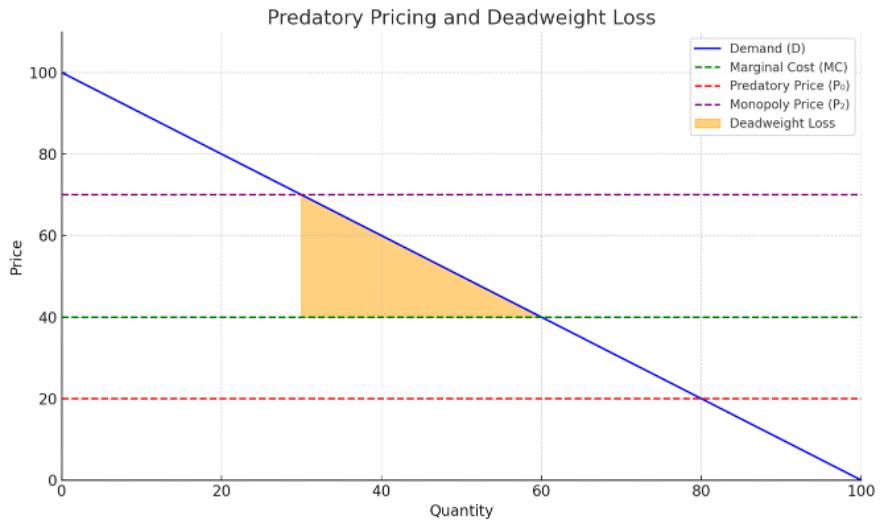
However, regulatory challenges are rooted in cost determination, which is the key element in proving whether the pricing is truly predatory.
Why Is Cost Determination Important?
In 2016, the telecom sector of India witnessed a disruption that altered the course of its competitive landscape forever. A company entered the market with an unexpected strategy – free voice calls and extremely cheap data rates. Reliance Jio had coerced established players like Vodafone and Airtel to significantly lower their prices – not just to compete, but to survive. Resembling what is known as the Areeda – Turner Test’s predatory pricing model, upon gaining market control and dominance subsequently, Jio raised its price. When the case was presented before the CCI, it ruled in favor of Jio citing a lack of recoupment evidence aligning with the global precedent set by the US Supreme Court in Brooke Group Ltd v. Brown & Williamson Tobacco Corp. This is why determining cost and how it is done is a pertinent challenge – one that the 2025 Regulations seek to address.
The 2009 and 2025 Regulations: A Shift In The Cost Metrics
The 2009 Regulations primarily rely on Average Variable Cost (AVC) as a proxy for Marginal Cost as seen in MCX Stock Exchange v. NSE. While widely used, it has significant limitations. When only AVC is used, firms engaging in fair competitive pricing may be penalised unfairly as many firms may tend to temporarily price below AVC due to operational strategies. The Regulations also allowed the CCI or Director General to engage experts for cost determination. Moreover, CCI retained its discretion in case of interpretation issues or unaddressed situations.
The 2025 draft Regulations provide greater cost flexibility by formalizing alternative cost concepts, i.e., total avoidable cost (TAC), average total cost (ATC), long run average incremental cost (LRAIC) to address the limitations of the AVC approach. This shift is particularly pertinent for industries with high fixed costs wherein AVC fails to provide an accurate long-term benchmark. Market value has been removed as a possible cost consideration. While moving beyond an AVC centric approach is a positive step, the economic rationale for choosing between the alternative concepts remains unclear as such discretion remains with the CCI. A sector-specific cost allocation framework wherein industries are pre-classified based on cost structure and capital intensity would be a step towards reducing enforcement uncertainty.
Internationally, competition authorities place importance not just on pricing below cost but also on the firm’s ability to ‘recoup’ these losses. The Indian framework could use an addition along such lines to make it less restrictive and reduce the scope of under or over regulation.
Beyond Traditional Metrics – Adapting to the Modern Markets
The discretionary breadth given to the CCI, however, may result in uncertainty and inconsistency in enforcement – it introduces regulatory unpredictability. Firms may find it difficult to predict which cost concept will apply to their industry, creating market uncertainty. To mitigate this, a more refined cost allocation mechanism could be formalized to align cost metrics with industry specific features, i.e., LRAIC would be used for capital intensive industries, ATC would be used for industries with high fixed costs.
Furthermore, these determinants are traditional and may not be fully applicable to digital markets with new age business models, i.e., platform economies, multi-sided markers or zero marginal cost industries wherein:
- Marginal cost is often close to zero.
- Revenue models are highly dependent on cross subsidization, i.e., one side funds the others.
- Platform economies and multi sided markets.
To tackle such industries, the CCI should shift to the use of opportunity cost-based pricing, which helps assess foregone revenue potential and consumer impact. For example, the EU considered how Google’s search algorithm diverted its internet traffic instead of looking at direct pricing as a way to deter competition.
Another method to address such markets is based on opportunity cost which is similar to the approach taken by the EU in the Amazon Buy Box and the US in Apple App Store Fee cases.
Two-Sided Market Considerations could be employed to evaluate cross subsidization effects, especially in industries particularly for digital services where the real competition occurs in ecosystem control rather than direct pricing.
Compliance Burden and Procedural Delays
Firms will now need a more robust information system and professional help to defend their pricing strategies due to expanded cost measures. Such a requirement can have the tendency to burden small enterprises, i.e., MSMEs. Furthermore, the draft Regulation reflects the absence of a definite timeline for such cost determination, which could significantly delay proceedings. By virtue of the 2025 Regulations, businesses can now also challenge cost assessments with expert involvements at their own expense.
A cost sharing mechanism would improve this cost burden where the CCI would partially contribute to the impartial expert if their final ruling is significantly different to that of the CCI. This approach is similar to the one employed by the Telecom Regulatory Authority of India (TRAI), Central Electricity Regulatory Commission (CERC) and Insolvency and Bankruptcy Code (IBC). This ensures that both the enterprises and the CCI remain responsible in their evaluations and appeals.
The draft Regulation furthermore takes a positive step that allows enterprises to seek expert opinions, but there is a clear absence of a standardized criteria for appointing such experts. The CCI may draw inspiration from the UK Competition and Markets Authority (CMA) which employs an independent advisory panel to avoid industry bias.
Conclusion
The Draft Regulations move beyond the rigidity of a singular metric towards incorporating multiple cost metrics, and such a framework has the bandwidth to tackle capital intensive industries. Yet, it does increase compliance burdens, introduce uncertainty in determination and does not adequately consider digital market structures. Effective enforcement without stifling legitimate competition would require the establishment of clear industry specific cost metrics, opportunity cost-based pricing for digital markets, cost sharing mechanism and standardized expert appointment criteria. Recoupment analysis in pricing evaluations is the need of the hour. To build a robust, future proof and truly anti-predatory competitive framework, the regulations must protect the ‘competition’ and not just the competitors.
The author is student of Gujarat National Law University.